
What is an Equalizer (EQ) in Music?
An equalizer, or EQ, is a fundamental tool in music production and audio engineering. It allows producers to adjust the balance of different frequency ranges in a sound, ensuring every element of a mix is clear, balanced, and sonically pleasing. Whether you’re enhancing vocals, sculpting instrument tones, or fixing problematic frequencies, EQ is essential for achieving a polished mix.
How Does an Equalizer Work?
An EQ divides audio into frequency bands—low, mid, and high—and lets you boost, cut, or shape these bands to achieve the desired sound. Frequencies are typically measured in Hertz (Hz), and the audible range for humans is 20Hz to 20kHz.
- Low Frequencies (20Hz – 250Hz): Adds warmth and bass.
- Mid Frequencies (250Hz – 4kHz): Shapes clarity and tonal character.
- High Frequencies (4kHz – 20kHz): Enhances brightness and airiness.
Types of Equalizers
- Graphic Equalizers
- What They Are: Feature fixed frequency bands controlled by sliders.
- Best For: Live sound and general audio adjustments.
- Example: 10-band or 31-band EQ hardware.
- Parametric Equalizers
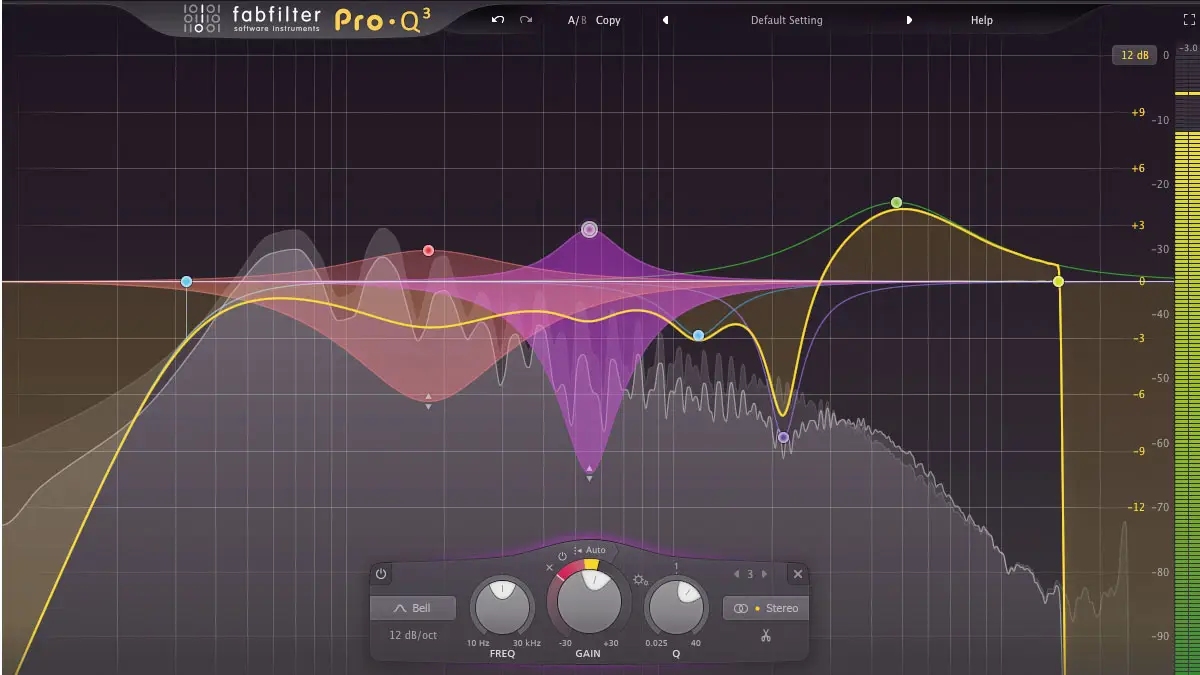
- What They Are: Offer control over frequency, bandwidth (Q factor), and gain.
- Best For: Precision editing in studio mixing.
- Examples: FabFilter Pro-Q 3, Waves Q10.
- Shelving Equalizers
- What They Are: Boost or cut frequencies beyond a specific point.
- Best For: Adding airiness to highs or warmth to lows.
- Example: High and low shelf EQs.
- Dynamic Equalizers
- What They Are: Adjust specific frequencies only when they exceed a set threshold.
- Best For: Fixing frequency imbalances dynamically without affecting the entire mix.
- Examples: Waves F6, TDR Nova.
- Linear Phase Equalizers
- What They Are: Maintain phase alignment for precise adjustments without phase distortion.
- Best For: Mastering and parallel processing.
- Example: iZotope Ozone EQ.
Common Uses of EQ in Music Production
- Enhancing Vocals:
- Boost 2-5kHz for clarity and presence.
- Cut 300-500Hz to reduce muddiness.
- Add airiness by boosting 10-15kHz.
- Sculpting Drums:
- Kick drums: Boost 50-100Hz for weight; cut 200-400Hz to reduce boxiness.
- Snare drums: Boost 2-4kHz for attack and presence.
- Fixing Muddiness:
- Cut 250-500Hz to clean up overlapping frequencies.
- Adding Brightness:
- Boost 8-12kHz on instruments like guitars, cymbals, and vocals.
- Balancing the Mix:
- Use EQ to carve out space for each instrument so they don’t compete for the same frequencies.
Tips for Effective EQ Usage
- Use Subtractive EQ First: Cutting problematic frequencies often sounds more natural than boosting.
- Solo Sparingly: Always check EQ adjustments in the context of the full mix.
- Avoid Over-EQing: Small, subtle adjustments are often more effective.
- Learn Frequency Ranges: Familiarity with frequency ranges helps identify what needs adjusting.
- Use High-Pass and Low-Pass Filters: Remove unnecessary frequencies to clean up the mix.
Recommended EQ Plugins for Producers
- FabFilter Pro-Q 3
- Versatile, intuitive, and packed with features like dynamic EQ and linear phase mode.
- Waves SSL G-EQ
- Modeled after the classic SSL console EQ, great for punchy and vibrant sounds.
- TDR Nova
- A free dynamic EQ with precision and flexibility.
- iZotope Ozone EQ
- Perfect for mastering, offering surgical precision and clarity.
- Stock DAW EQs
- Most digital audio workstations (DAWs) come with capable EQ tools that are excellent for most tasks.
Final Thoughts
An equalizer is like a sculptor’s chisel—it shapes your sound and helps bring your creative vision to life. Understanding the types of EQs and their uses is crucial for anyone working in music production. Whether you’re adding warmth to a bassline or enhancing the sparkle of a vocal track, EQ is a powerful tool that can transform your music.
Let us know in the comments: What’s your favorite EQ plugin, and how do you use it in your mixes?