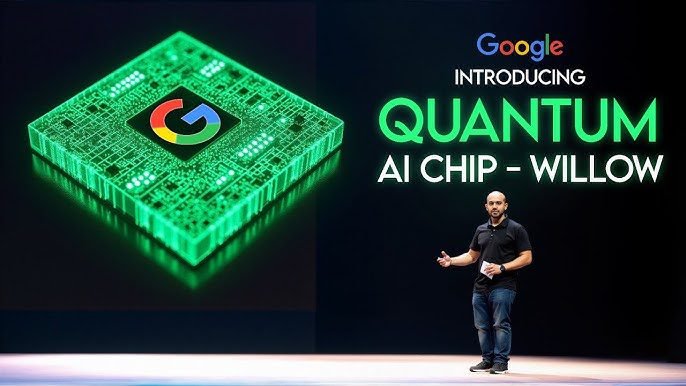

Unveiling Google’s Quantum Chip: A Leap Into the Future of Computing
In recent years, the concept of quantum computing has shifted from theoretical discussions to groundbreaking developments. At the forefront of this technological revolution stands Google, with its cutting-edge quantum chip that promises to redefine what is computationally possible.
What Is Quantum Computing?
Quantum computing differs fundamentally from classical computing. While classical computers rely on bits—binary units of 0s and 1s—quantum computers use quantum bits, or qubits. Qubits can exist in a state of 0, 1, or both simultaneously (a phenomenon known as superposition). This, coupled with entanglement—a property where qubits become interconnected and the state of one affects the other—allows quantum computers to process complex calculations at speeds unattainable by classical machines.
Google’s Breakthrough: The Sycamore Quantum Processor
In 2019, Google announced a pivotal achievement with its Sycamore quantum processor. This chip, equipped with 54 qubits, was capable of performing a computation in 200 seconds that, according to Google, would take the most advanced supercomputers approximately 10,000 years to complete. This milestone was hailed as achieving “quantum supremacy”—the point where quantum computers outperform classical computers in specific tasks.
Although this claim sparked debates within the scientific community, it underscored the immense potential of quantum technology. Sycamore’s success was not just a demonstration of computational speed but also a testament to the robustness of Google’s quantum chip architecture.
Applications of Google’s Quantum Chip
The capabilities of Google’s quantum chip extend far beyond theoretical experiments. Quantum computing holds promise in various fields, including:
1. Cryptography: Breaking and building encryption systems could become exponentially more efficient, leading to both security challenges and advancements.
2. Drug Discovery: Simulating molecular interactions at an atomic level to expedite the development of new medications.
3. Optimization Problems: Solving complex logistical challenges, such as supply chain management or traffic flow optimization, with unprecedented efficiency.
4. Artificial Intelligence: Accelerating machine learning algorithms and enabling AI systems to tackle problems currently beyond their scope.
Challenges and the Road Ahead
Despite these advancements, quantum computing is still in its infancy. Google’s quantum chip, like others in the field, faces significant hurdles:
– Error Rates: Qubits are highly sensitive to environmental disturbances, leading to computational errors.
– Scalability: Building quantum processors with thousands or millions of reliable qubits is a daunting engineering challenge.
– Practical Implementation: Bridging the gap between experimental success and real-world applications remains a work in progress.
To address these issues, Google and other players in the quantum race are focusing on innovations in error correction, hardware stability, and software development.
Why Google’s Quantum Chip Matters
Google’s advancements in quantum computing represent more than just technological prowess; they mark the beginning of a new era. As quantum technology matures, its potential to disrupt industries, solve complex global challenges, and expand our understanding of computation becomes increasingly apparent.
While the journey to fully functional, large-scale quantum computers is far from over, Google’s quantum chip is a bold step forward. It reminds us that the future of computing is not just faster and smaller but fundamentally different, promising a paradigm shift that could redefine our digital world.
As we stand on the cusp of this revolution, one thing is clear: quantum computing isn’t just about what computers can do; it’s about what humanity can achieve with them.